My role
I led the team across mechanical design, electrical integration, and Arduino firmware, moving regularly between 3D modelling, component selection, soldering, precision cutting, enclosure assembly, and technical documentation. My main responsibility was keeping those streams connected, because changing the geometry of a material path could alter the actuator load, wiring position, and control timing at the same time.
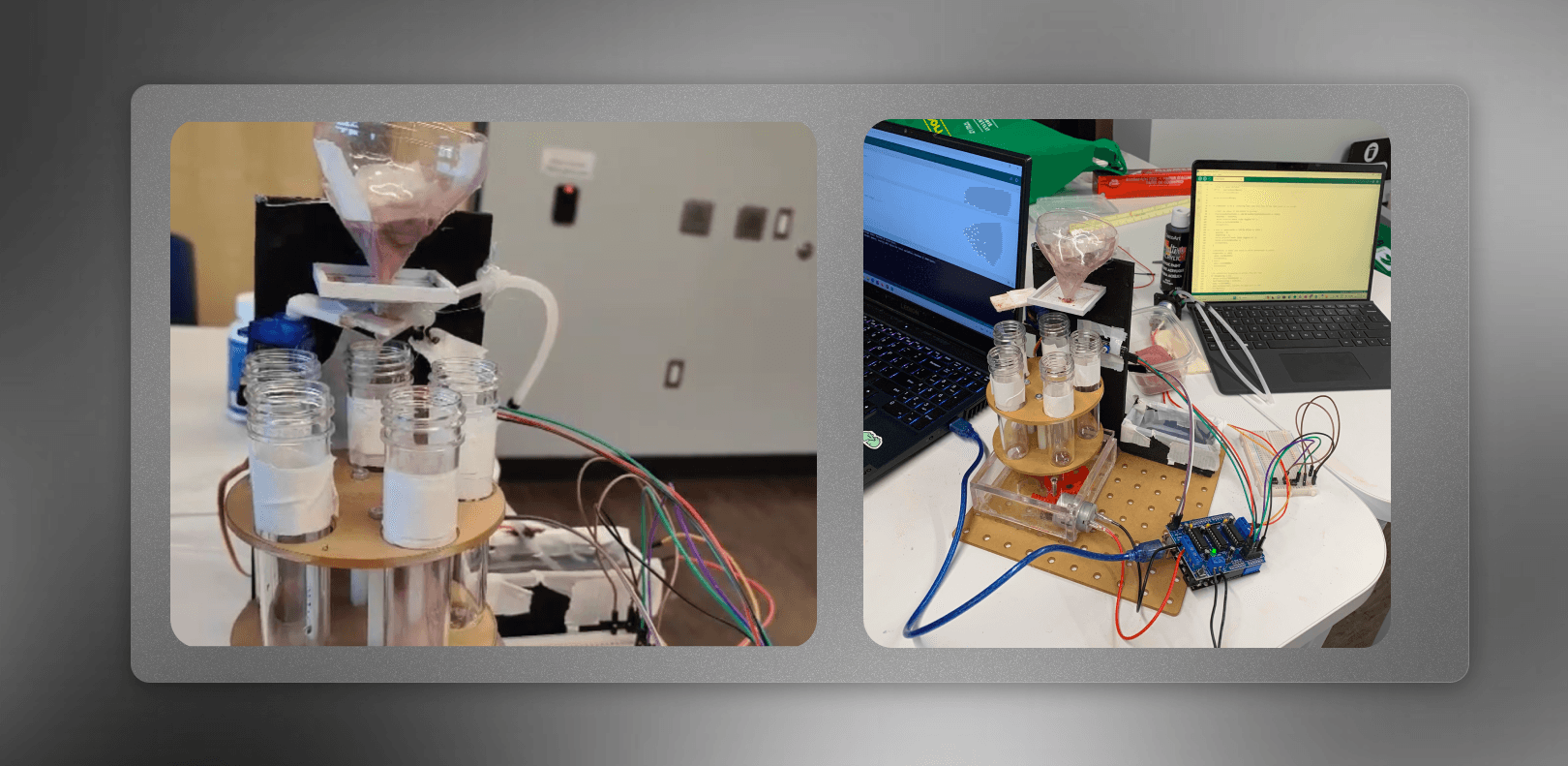
We kept a rough version of the full assembly on the bench while we worked, which let us check clearances and material flow before fixing the enclosure in place. It was messier than testing each part alone, although it caught several cases where a mechanism fit in the model and interfered with the wiring or reservoir once installed.
Liquid and powder
Liquid and powder required different dispensing mechanisms, even though both had to respond consistently to the same control interface and fit inside one enclosure. The liquid side depended on predictable flow over time, while the powder side had to deal with settling, friction, and clumping. We used the Arduino to coordinate both actuators and translate the requested mixture into separate run times for each material.
Both mechanisms had to stop cleanly because residual flow after an actuator switched off changed the ratio in the cup. Our measurements included what left the machine after the command ended, and that behaviour influenced both the physical outlet design and the firmware timing.
Calibration
The final stage centred on calibration because small mechanical changes altered how much material was released during a fixed actuator interval. We ran repeated dispensing tests, measured the output from each side independently, and adjusted the timing against the assembled machine before testing the combined drink again.
The timing values changed again after we installed the reservoirs and closed the enclosure, even though the firmware itself had not changed. We did the final calibration on the assembled dispenser with the Kool-Aid powder and liquid we planned to use in the demonstration, then kept those values with that exact mechanical setup.